RaMaDaSa ReMeDy
Gayatri’s Story – The Becoming
In the earliest age, the metres consisted of only four syllables. The gods asked them to bring Soma from the heavens. (Soma was a sacred plant from which a ritual drink was pressed; much of Vedic poetry is dedicated to it.)
The first to leap upward was Jagatī. She flew toward the celestial realm but returned without the Soma, leaving behind three syllables.
The second to rise was Triṣṭubh. She too ascended but came back empty-handed, leaving behind one syllable.
Then the third ventured forth—Gayatri, who took the form of a hawk and soared upward in search of Soma.
When the Gayatri bird appeared, she startled Soma’s guardians and carried off the sacred plant. She flew so swiftly that it seemed she alone travelled the vast celestial path. With the sweet Soma in her grasp, she sped back to the earth. From that moment, hawks gained a place of honour in the world.
The Gayatri hawk, guided by the gods, brought the exhilarating Soma down from the lofty heavens.
And not only did she return with the Soma—she also brought back the four syllables left behind by Jagatī and Triṣṭubh. From that celebrated day onward, Gayatri carries eight syllables in each pada, each “footstep.”
And it is Gayatri alone that can transform herself into other metres by adding four syllables at each step.
Siri Gayatri Mantra
Ra Ma Da Sa Sa Say So Hung
Ra Sun Ma Moon Da Earth Sa Infinity Sa Infinity Say the personal perception of infinity So Hung I am that
Exploring the Roots
If you're familiar with the world of mantra, you likely know the classical Gayatri Mantra. Yogi Bhajan's Siri Gayatri is an entirely different composition. So why did he give it that name? What was he invoking when he called this healing mantra, woven together from several shorter mantras, the Siri Gayatri?
One way to understand the connection is to look at the ancient story of Gayatri itself.
Gayatri is perhaps the most widely known mantra of the Vedic tradition. The Vedic lineage traces back to the ancient civilization of Northern India (c. 1500–500 BCE), centered around the Ganges basin. It is named after the Vedas- the oldest scriptures of the Indian wisdom - where Veda means “knowledge.”
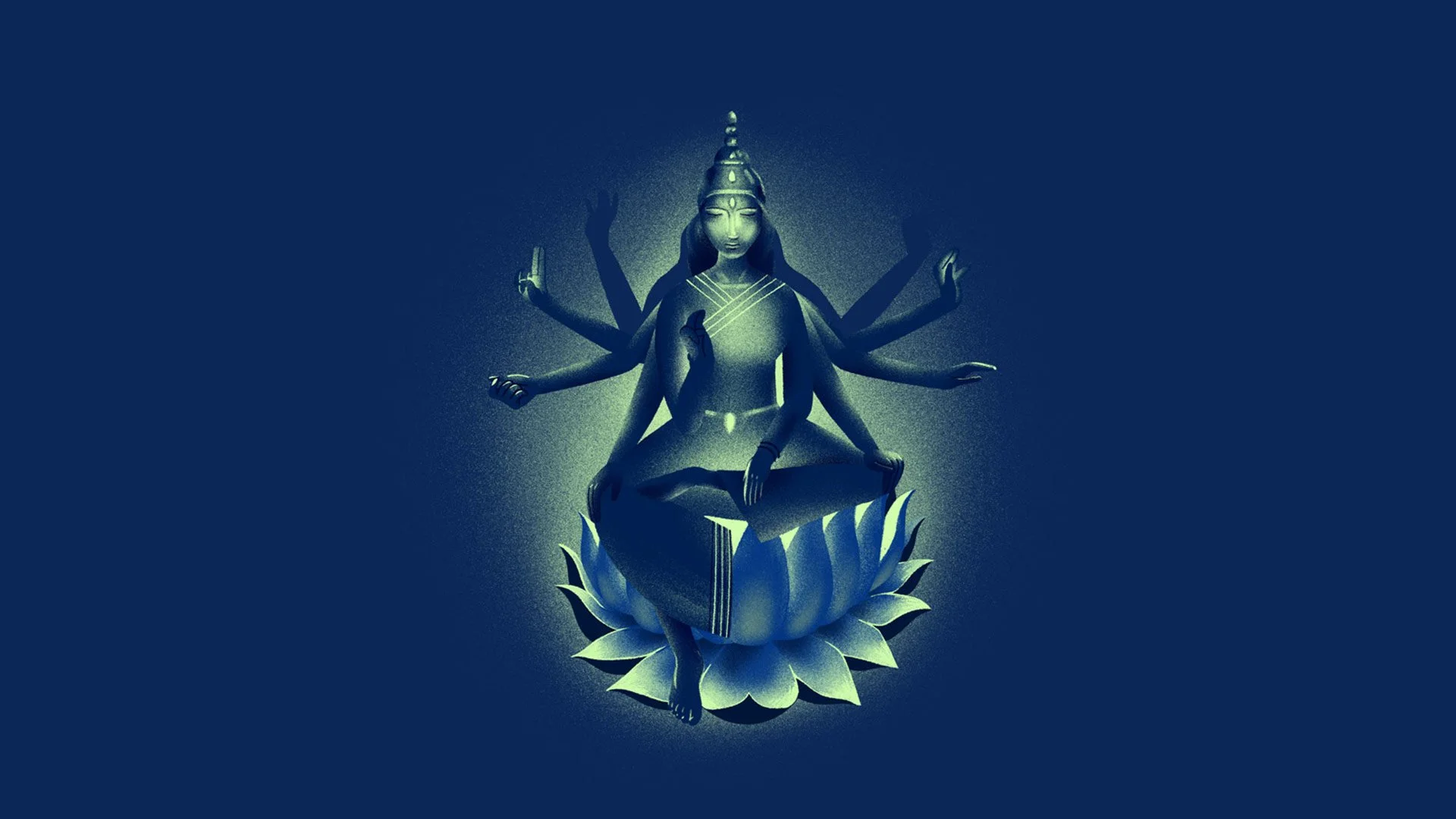
“Gayatri” is not only a mantra; it is also revered as a Goddess. Her essence is linked to the uplifting quality of Gayatri as a chandas—a Sanskrit term meaning a metrical form, a rhythmic pattern through which poetry is shaped. A chandas is the mould that turns sound and language into rhythmic, poetic expression.
The Gayatri metre is the form through which the largest number of Vedic hymns emerged. Over time, this led to Gayatri being honoured as the “mother of the Vedas,” since many Vedic mantras were composed within this twenty-four-syllable pattern (three lines of eight syllables).
The Rhythm of Eight in Kundalini Yoga
In Kundalini Yoga, the rhythm of eight is used frequently, as it resonates with and activates the awakened consciousness known as Kundalini, and its movement through the eight chakras.
With this in mind, Yogi Bhajan’s reference to the healing mantra as the “Siri Gayatri” begins to make sense. Maybe he was pointing to the potent, elevating essence carried in the ancient Gayatri story.
Just as the Gayatri hawk flew beyond the sun carrying the four gathered syllables, the four base sounds of the Siri Gayatri mantra:
Ra Ma Da Sa
carry our awareness from earth to ether, from the tangible world into the celestial realms:
Sun, Moon, Earth, Infinity.
Then, like the hawk returning with the uplifting Soma, the second half of the mantra:
Sa Say So Hung
holds us in that expanded space for a moment. It allows us to gather the remedy of expanded consciousness before guiding us back home to the Self:
the recognition that all that is, is Infinity -
and I Am.
A Journey of Distillation and Re-Integration
On this journey in the Bardo, this space of disintegration and integration, I am exploring the distilled essence of the practices taught by Yogi Bhajan. I am looking at different contexts, different mantras, new interpretations, and new combinations.
When we focus on the most basic component of a practice - the metre, the rhythm of the mantra -we can explore the experience of these meditations (particularly the 22 meditations of the Ra Ma Da Sa Remedy collection) through other mantras composed to the same eight-beat rhythm.
These may be other mantras from the yogic tradition, or sacred sounds from any tradition or language that resonates with you.
Try it.
Rise and soar with Gayatri.
The Goddess is not bound to any one culture,
she is rhythmic, fluid, and spacious,
and she can be expressed through many different sounds.
I’m very curious to know about your explorations.
Please stay in touch, and share your journey.